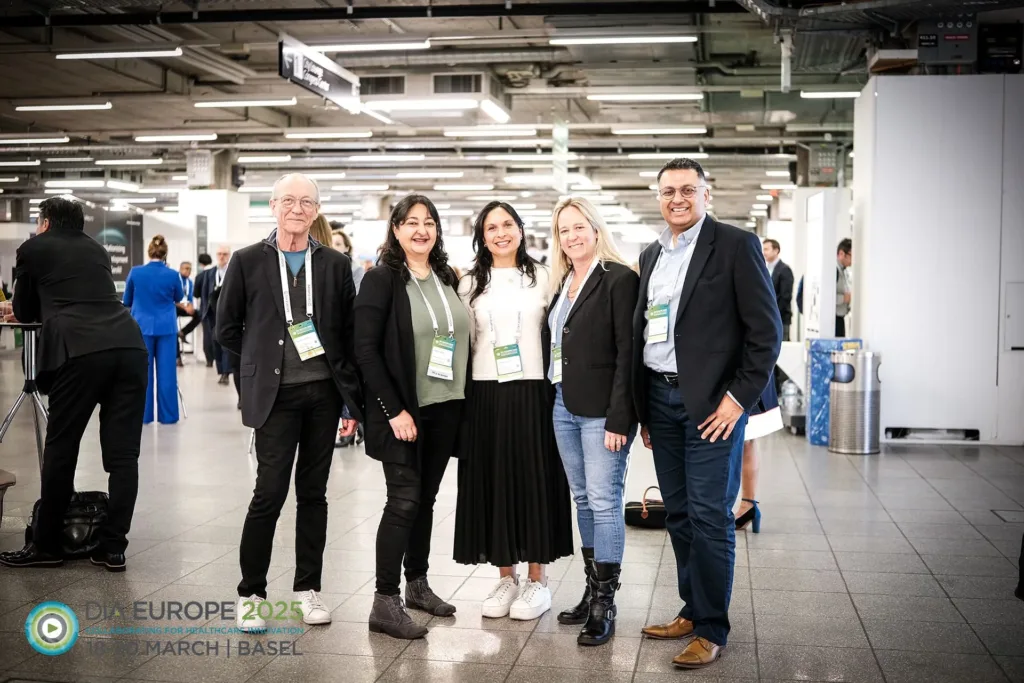
At the DIA Europe 2025 conference, one of the most compelling sessions was titled “AI Solutions through the Drug Life Cycle with a Focus on Safety.” The session brought together experts from three companies, each presenting practical case studies on the integration of AI across pharmacovigilance (PV), medical device safety, and clinical documentation.
Shelley and Sabita attended this session and here’s a quick overview of the key presentations and what we learned:
1. AI in Pharmacovigilance Operations
It was demonstrated how AI is already embedded in PV workflows, delivering measurable efficiency gains. Examples included:
- Narrative Generation for ICSRs: Automating case narratives cut processing time from ~30 minutes to just 1 minute per case.
- REMS Reporting & DSUR/PSUR Sections: AI was used to pre-populate standardised content, summarise safety data, and extract key figures like SARs and outcomes.
- Data Tabulation & Reshaping: AI tools restructured complex safety datasets into regulatory-ready formats.
Key Takeaway: AI can greatly speed up routine PV documentation tasks, but human review remains essential to ensure clinical accuracy and contextual judgement. It was also cautioned about the need for validation, data privacy, and robust oversight of AI tools.
2. AI-Enhanced Medical Device Complaint Reporting
Use of AI in medical device safety focusing on complaint processing. The approach involved:
- Digitised AE Reporting: Reporters were given structured, user-friendly forms that generated AI-readable PDFs.
- AI-Generated Preliminary Assessments: Reports were reviewed in seconds with AI using pre-programmed templates.
- Human-in-the-Loop Finalisation: Clinicians then validated or amended the AI output before finalising submissions.
The results showed no loss in accuracy, while dramatically improving time efficiency.
Key Takeaway: When paired with thoughtful human oversight, AI-enabled reporting can streamline safety assessments without compromising quality – especially for medical device reporting, which often suffers from manual inefficiencies.
3. AI in Clinical Documentation and Medical Writing
The presenting company shared a broader, enterprise-level implementation of AI across clinical documentation, especially in regulatory writing. Highlights included:
- Automated Drafting: AI generated content for study summaries, ICFs, and plain-language documents, speeding up document creation by up to 70%.
- Tailored Outputs: Their AI tools were trained to simplify language for patient-facing materials while ensuring regulatory compliance.
- Agile & Continuous Learning: Their implementation followed agile and Kaizen principles, allowing for regular improvements and feedback incorporation.
Key Takeaway: Beyond efficiency, AI can improve the clarity, accessibility, and standardisation of clinical documents, helping teams refocus on strategy and critical thinking.
Final Thoughts
This session offered a realistic and optimistic view of AI’s role in drug development – especially in areas where repeatable processes can be automated, freeing up human expertise for more complex decision-making.
At Sagittal Pharma Consulting, we’re energised by the potential AI offers across the safety and regulatory spectrum. But we also echo the presenters’ shared wisdom: AI is a tool – not a replacement. Human oversight, rigorous validation, and ethical considerations must remain central as we integrate these technologies into our workflows.